»Just a little bit of history repeating« – Reviving public transport thanks to the safeguarding of heritage
Transitioning from a historic site to the future of public transport? In this interview, we get to feature Dr Harald Elsner, president of the association “Verein Verkehrsamateure und Museumsbahn e.V..” Due to the association’s long-term preservation efforts, regional politicians were inspired to reactivate the historic railway line for modern public transit. Regular commuter services are scheduled for late 2027. We look at the association’s decade-long preservation efforts and the overall interesting sights as well as the new developments, chances and risks.
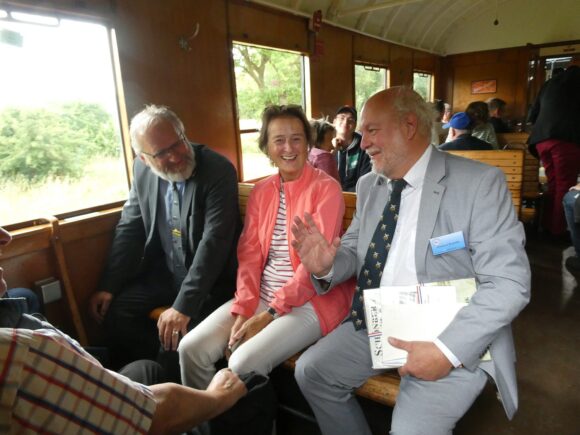
IATM: Historic railroads require maintenance, upkeep, and, above all, a great deal of dedication. For 50 years, the “Verein Verkehrsamateure und Museumsbahn e.V.” (association of transport enthusiasts and museum railway) has been caring for a small piece of cultural heritage. You’re the president of the association, Harald — what does the association do, and who are “you” all?
Harald Elsner (HE): The association was formed in 1968 through a name change from the former “Kleinbahn-Verein Wohldorf,” which had been founded back in 1958. Its chairman (my predecessor’s predecessor) had already acquired an electric light railway car from the Elektrische Kleinbahn Altrahlstedt-Volksdorf in 1957, placed it in his garden, and put up a sign that said “Museum.” That was likely the oldest non-governmental railway museum initiative in Germany.
Over the next years there were some ups and downs, initiatives and changes. Ultimately, in 1972, we were able to rent the locomotive shed in Aumühle near Hamburg, which had previously been used as a steam locomotive shed, and in 1976—50 years ago—the first historic train ran on the route from Schönberger Strand to Schönberg in Holstein. There, with the help of job creation programmes, we succeeded in building our own small tram line, on which our trams have been in operation since 1993.
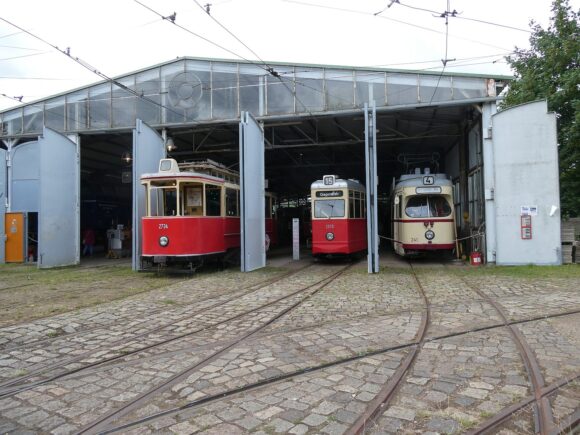
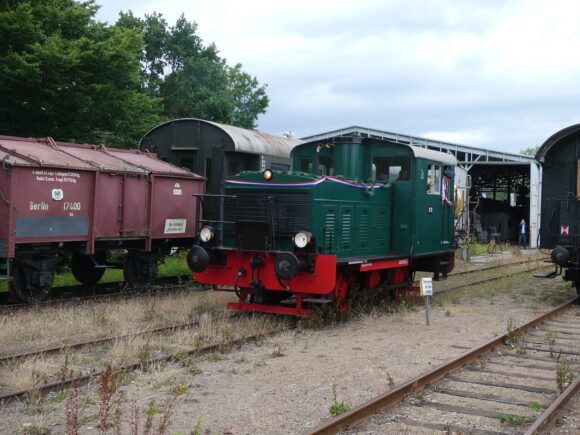
We entered the 21st century with advanced locations. In 2004, we were able to purchase the Aumühle locomotive shed and develop it into a railroad museum, complete with an additional track, several more shelters, and an impressive collection of old railroad vehicles—many of which are the last of their kind.
In Schönberger Strand, we operate the only museum railways in Germany where historic rail vehicles (the oldest car dates from 1898) and historic tramways (dating back to 1894) can be seen in operation together. The tramways even feature two different track gauges and two different power collection systems. Since 2010, we’ve also been running a small museum in Hamburg-Wohldorf featuring small exhibits and a model railway.
Our association currently has about 350 members. More than 100 people are actively involved in some capacity, ranging from “all the time” to “very occasionally”—as is often the case with associations.
IATM: With the historic trains, you also travel along the former public transit route between Kiel and Schöneberger Strand near the Baltic Sea. Who uses your service?
HE: Our visitors include tourists, families, school groups, tour bus groups, people visiting the beach and those from the region. We have far more “chance visitors” than train enthusiasts. And, of course, word has spread about the museum railways, which are also promoted locally as a tourist destination.
In public transit, however, the museum railways play virtually no role—instead, a parallel bus line has been running hourly since 1975.
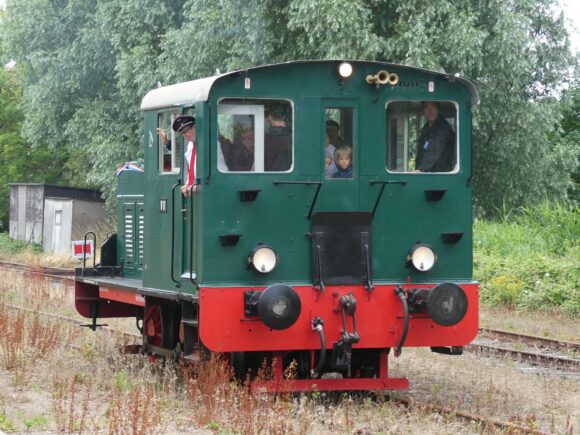
IATM: Now that politicians have taken notice of the line, they want to revive it for public transit. What are their motivations? Did you play a role in the decision?
HE: We were involved in the development from the very beginning.
For years, the discussions revolved around disconnecting the „Schönberger Strand–Schönberg“ section of the former Kiel–Schönberg Railway from the network as an “island line.” In the 1980s, passenger numbers were low and freight traffic was becoming increasingly insignificant. However, when the Schleswig-Holstein Local Transit Association (NAH.SH GmbH) was founded the 1990s, they conducted a study to determine which abandoned rail lines were suitable for reactivation.
As a result, the Kiel-Schönberger Strand line has been a political priority for about 20 years now. The reasons are manifold, from shorter travel times compared to buses, aimed to result in an increase in ridership, a shift away from private vehicles, thus relief for commuter traffic to and from Kiel, and—if operated with battery-powered railcars—a contribution to environmental and climate protection.
The current regional train line RB76 – operating hourly at the moment, is set to be extended in two steps, the latter set to be finished in December 2027 with the terminal station Schönberger Strand. The modernisation is underway since February 2025 (planning approval).
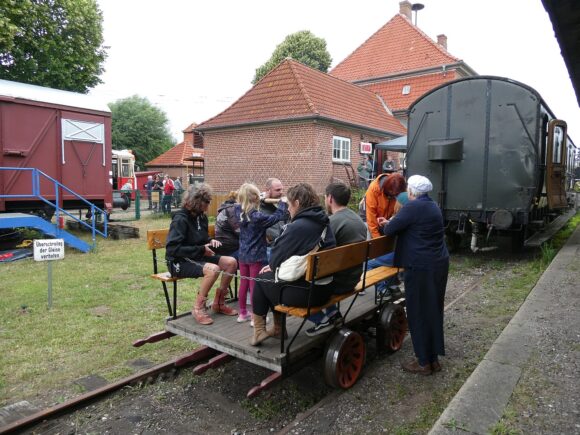
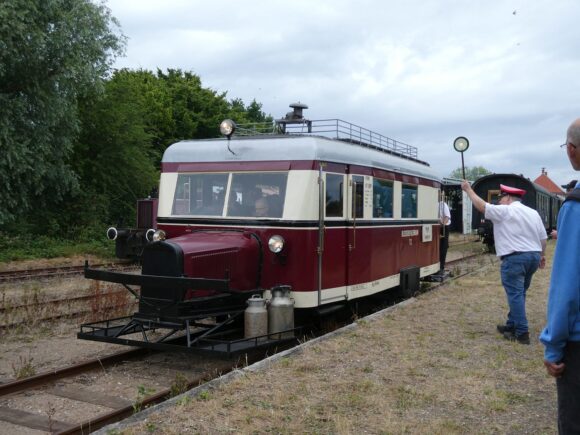
IATM: Without your years of maintenance, this plan would have been impossible today—or it would likely have required an enormous amount of effort. So you’ve preserved an important part of the region’s infrastructure. What lies ahead for you now?
HE: The fact that we’ve been co-owners of the Schönberger Strand–Schönberg line for many years (together with the municipality of Schönberg) has certainly helped in this regard. As railway enthusiasts, we naturally support the reactivation of a line that was previously taken out of passenger service. To us, it is of course very, very important that we remain present at the Schönberger Strand location and can operate historic trains from there on the route to Kiel (and possibly beyond).
We expect the Schönberg and Schönberger Strand stations, as well as several railroad crossings, to be renovated next year. We also anticipate the construction of a new siding for some of our historic railway vehicles currently stored at Schönberger Strand.
There is no doubt that the modernisation work will significantly alter the character of the stations. The ‘local railway atmosphere’ of the period from 1912 to 1975 and of the museum railway era since then will largely be lost. But we are confident that there will be an exciting coexistence (or interplay) of the new and the old. And every day, every hour, people will be brought to our museum station by train. We are keen to see how this will play out economically, but also in terms of increased use of the museum facilities – and, in the worst-case scenario, vandalism. We still believe that the opportunities outweigh the risks.
IATM: At our next annual conference in September, we’ll be discussing transport and communications museums as drivers of change. In this case, you have been the driving force that is now enabling the region to revitalise its infrastructure. Will we be able to meet you in Belfast, and will you be reporting on the latest developments to IATM members during ‘News from the Field’?
HE: I will be in Belfast and may provide an ‘update’ on the latest information – from our anniversary celebrations on 4 July, but also on the progress of the construction work and perhaps further developments.
IATM: What are you most looking forward to at the IATM conference?
HE: “Changing the Script” is a fascinating topic: transport museums and heritage railways, as well as postal and telecommunications museums, showcase technical cultural heritage within an increasingly fast-changing technical, economic and social environment. Will we still be presenting our railways and trams – and our colleagues their ships, aeroplanes, cars, models and so on – in the same way as we do today? Which stories do we tell, what should be preserved at all costs? What seems less important as times change, and what might, in hindsight prove to have been a mistake?
I’m looking forward to finding out how others are dealing with this change. I’m looking forward to enlightening discussions. I’m looking forward to visiting interesting museums in Northern Ireland. And, of course, I’m also looking forward to stimulating evenings with excellent Northern Irish food and fine Northern Irish drinks.
Thank you, Harald, for the insightful interview. We are looking forward to seeing you in Belfast, Northern Ireland in September!